Thursday, December 23, 2010

Jessie's end-of semester Appalachian Project

For our Appalachian studies we had to choose a project to do. This is the project that I chose to do: I made a pot holder, and I did everything by hand.
   I started by measuring out the pieces, and cutting the pieces out. Then, I pieced it together, and sewed the back to it. Then, as you can see in the picture above, I quilted X's on each square. I used blue/green thread on the dark green cloth and dusty yellow for the flowery pieces, which is why it is hard to see.
   It took me about four hours to cut the pieces, piece the pieces together, then sew the back to it. It took me two and a half hours to quilt it.

   Quilting was not an art a long time ago in Appalachia. It was more of work to make them warm. They were almost always made out of old clothes or blankets or anything that was cloth, and could be sewn. But now it is an art to make quilts because they do not make them a lot now a' days.
   All I know is that it was fun making it and it will be very useful to my parents! It was very easy to make and the only time I asked for help was when I was cutting out the pieces and sewing the back to it! I also plan on making a quilt soon. Can't wait to get started!

Tuesday, December 21, 2010

Appalachian Christmas Stories

Today we read two great Appalachian Christmas stories:

Silver Packages: an Appalachian Christmas story by Cynthia Rylant. And...
Littlejim's Gift: an Appalachian Christmas story by Gloria Houston.


The kids enjoyed both of them so much they wouldn't let me take them back to the library. Silver Packages is mostly based on the true story of the Santa Train, a train that began in 1943, going through the mountains distributing gifts to children.
   Littlejim's Gift is set in the mountains of North Carolina during the first World War, but it included many Christmas traditions that were typical in many towns all across Appalachia, including recitations in church, the tradition of St. Nicholas coming into the church to give out gifts, and each child (and adult!) receiving a brown paper poke (bag) with oranges and nuts and candy inside.
   In other news, the kids are hurrying to get their end of the year projects finished. Jessie is sewing wildly on her quilt and and TJ has his questions ready to interview Granny Dot today. Projects should be up and on the blog soon!

Thursday, December 2, 2010

December 2, 2010

So, we've finally finished our journey through Faces of Kentucky, the Kentucky history textbook. Jessie and TJ are each going to blog about their favorite subject in the book. Jessie chose to write about one-room schoolhouses and what it was like to go to school in the early days of the Commonwealth. TJ wants to write about Kentucky musicians and songwriters. Here goes:

Jessie writes:
So when schools first started in Kentucky there was a lot of danger, violence and just lots of bad stuff happening. But everyone thought that kids should be taught even if there was danger everywhere. So kids started having school in forts and then rough schools. Adults back then had a different view of school. They thought that schools shouldn't be public, which means they shouldn't be paid for by the State. So many private schools called academies started. So the education of Kentucky wasn't going so well. But after all this, one room schools that were public started showing up. Those schools were not very good schools because there could be fifty students and only one teacher in each school. Also because there was a lot of school violence such as kids bringing guns and knives to school. But that is not new now in our schools. Lots of one room schools were not built very well. One school was made out of logs, so the cracks in between the logs were very poorly filled. So the cold wind would blow through regularly. One boy recalled, "The ink could not keep from freezing." Mainly the only furniture in the schools were benches with no support on the back, a coal or wood stove to keep the school warm, a desk for the teacher, a water bucket for water. If they ran out of water they either had to get it from a well in the school yard, or from a stream or spring far from the school. Sometimes the schools would have a black board. The black board would be a wall thats painted black or just a plain black board.  So a man named Robert J. Breckinridge observed that many of those schools were only getting $15 dollars from the state. So Breckinridge got a tax passed so that the schools got all the money they needed.

TJ writes:

When the Europeans came to Kentucky, they brought music with them. They sang songs to other people, but by memory. Kentuckians have used a lot of folk songs that were like the songs that the Europeans sang. The people such as John Jacob Niles,  from Louisville and then central Kentucky, Mary Wheeler from, Paducah, and Jean Ritchie from Perry County in Eastern Kentucky wrote down the songs that the Europeans sang. They didn't want these songs to be forgotten. These songs told the people about families, and times long ago.

Kentucky didn't just play folk music. They began to write new songs and music. One of those people that wrote original music was Stephan Collins Foster. He wrote My Old Kentucky Home," and "Oh! Susanna." The song called "Oh! Susanna" is "the birth of pop," and he wrote many songs that we sing today. He wasn't really connected to Kentucky except for the title of the song, "Happy Birthday."

 
In the the next century, music from Kentucky started to become popular in the USA (United States of America). Country music became very popular, and people from Kentucky made it popular. 7 people at least whose hometown was in Kentucky or made their home Kentucky made it to the CMHF (Country Music Hall of Fame). The 7 people that went to the CMHF included, "Red" Foley from Madison County; "Pee Wee" King, who lived in Louisville; Merle Travis from Muhlenberg County; "Grandpa" Jones from Henderson County; Loretta Lynn from Butcher hollow; and the Everly Brothers from Brownie, Kentucky.

Friday, November 12, 2010

November 12, 2010 - TJ writes about coal mining

Coal Mining was a big deal in Kentucky. That was one of the main jobs you could work for. Here is a story about a coal miner named, "Sam Hawkins."

Sam Hawkins was an African American miner who dug coal out of the hills near Fleming, Kentucky, (in Letcher County). The year of 1932 wasn't a good year for Sam Hawkins. Hard times like this year meant less jobs and smaller pay checks. It was really hard for Sam because that was the year his wife, Sadie Hawkins, died. Sam was 48. The love remaining of his life was the only child he had, Margaret, who was 19 at the time. Margaret had gone to college at what is now KSU (Kentucky State University). Sam couldn't read anything, but he hoped Margaret would have a better future then he had.

But, one day, things got worse. A man read a letter to Sam that was from Margaret. In the letter, she told him about how school was going, and that she was doing well. Then she wrote, "I think I'm gonna have to quit school in a few days. I'm out of money. Unless you can send me $10, I will have to come back home." Back then, $10 is like $10,000 today. He couldn't borrow the money because I'm sure there wasn't a lot of people around that had $10 on them. Sam went to his boss. His boss said that there was a section of a mine that was too dangerous to mine. It could cave in at any time. But if Sam wanted to try it, his boss would let him. The pay was 31 cents every 2,000 pounds of coal. Sam dug coal for almost 5 hours, then he ate some food. Then he dug coal for the rest of the night. The walls groaned but held. He kept working. 20 hours later, he came outside, to rest for a little bit. The wall of the mine fell. Sam mined all his coal and was quick enough to survive. He got $11 for digging coal. That's about 70,000 pounds of coal! He sent the money to Margaret. She soon got her college degree, and she came back and taught.

AND THEY LIVED HAPPILY EVER AFTER (except that Margaret died).

Harry Caudill wrote a book about this story. At the end he used these exact, same words, "Sam had put little white markers at the graves of his wife and his daughter but no one ever got around to making his own. Perhaps a coal shovel thrust into the earth like a bayoneted rifle over the bones of a fallen hero would be appropriate for such a man."

THE END!

Thursday, November 4, 2010

Slavery and Civil War

Jessie is going to write about slavery and how it led to the Civil War:

Slavery was a big thing in Kentucky when people first started to live here. As you might know most slaves were African American, and back then people thought that African American people were not as important as them (White people). So, as I said before, there were many slaves back then. So many that most Kentuckians (except for those who couldn't afford them) had at least one slave. Though many slaves did get freed or fled.
I read about one man who worked as a slave, but also had a job so he got paid. Very few slaves got the opportunity to have two jobs and get paid for one of them. The man had a wife and I think a few kids. He worked and worked and earned money until he had enough to free his wife. Then he worked more and earned more money until he freed every one, but himself. He kept working to free more and more slaves that were friends and family. Finally he freed himself. Very few slaves get that opportunity to free themselves. Though most slaves got freed when they were a certain age or when their owners died. So there were slaves everywhere!
The sad thing is that a lot of families, if slaves, get separated. I also read that one time at an auction, a family of slaves, a mother and a father, three kids, one four, one eleven and one just a few months old, were sold. First the eleven year old was sold, then the four year old -to another person- then the mother came up holding the baby,someone yelled out "Sell them separately!". So the baby was taken from the mother and the mother, father, and baby were all sold separately. Isn't that sad?
It got so bad that the north started to do something about it. And that started the Civil War. The Civil War had two sides. The north side, that was called the Union. They were against slavery. The south side, that was called the Confederacy. They were for slavery. I do not think that slaves fought, but I do not know for sure.
A sad thing about the war was that a lot of families fought against each other.I heard many stories about that. I also read about these two girls who were both from different sides, were talking about one side. Here is what they said: Girl #1 from South talking about North: "They were the worst things I had ever seen. Instead of uniforms, they were wearing old gray cloaks and looked absolutely miserable!" Girl #2 talking about North. From north: "The people who are fighting on our side are absolutley wonderful! The general is the right man for the job and is very handsome!"

That is pretty much all I know and can remember from what we have read about slavery and Civil War.

Tuesday, October 19, 2010

October 19


Last Wednesday, we went on our field trip to the Kentucky History Museum in Frankfort! The quote on the building says, "...so all Kentuckians may discover their roots in time and place."


The kids and Daddy standing on a model of a boat pioneers used to travel down the Ohio river to get to Kentucky.


They wanted their picture taken in front of every quilt. There were a lot of quilts!


My friend, John G. Fee. I just had to take his picture.


TJ writes: This is Abraham Lincolns REAL watch. The watches back then are different then the watches of our time.

Abraham Lincoln was born near Hodgenville, KY, on Feb. 12, 1809. He died at age 56. His family left KY 7 years later.

When Lincoln was talking about the Civil War, he said:
"I think to lose Kentucky is nearly the same as to lose the whole game..."
Abraham Lincoln, 1861


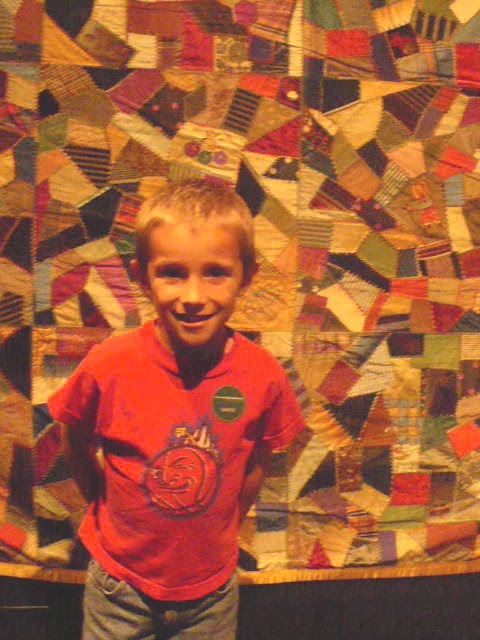
David wanted his picture taken in front of this crazy quilt. Crazy boy, crazy quilt.


What can I say. We like quilts.


Jessie wanted to take this picture of a Victorian-style living room.


A piece of Kentucky coal.


Authentic moonshine still. Ha ha!


Coal miner's equipment. They had a big section for coal mining, including a set-up of a company store with a display of scrip. Tim explained it all to the kids. They decided the company stores were a rip-off. After you got paid your scrip and bought your stuff, you didn't have much money left.


Coal camp in the mountains of Eastern Kentucky.


Jessie writes: This is David in front of one of my favorite quilts at the museum. It was made by a little girl, but that girl did not finish it until she was around fifty years old (I think). The top of the quilt took her a few years to make. She started at the age of eight and she was about ten or eleven when she finished the top. If you look at the quilt closely,you can see that the pieces are very small.She finished the whole thing when she was around fifty, or fifty five years old, at the beginning of World War II. I learned that a lot of the only blankets that they had back then were pretty much all quilts, even though they all took extremely long to make. Back then,
materials for quilts were expensive, so sometime people, when they made quilts, used old clothes, or any other cloths.


Swinging bridge over a creek at a home in the mountains. You can still see bridges like this in Eastern Kentucky. We all walked across one before!


Small tobacco farm in the mountains.


This is the ACTUAL CAR that Bobby Kennedy rode in during his famous tour of Eastern Kentucky.


When we got to the exhibit about Kentucky in the '50s, '60s and '70s, Tim stared at this TV for a long time. "I had one that looked just like this growing up!" he said. I took a picture and didn't know until I went back that I had caught Colonel Sanders on the screen!


When we left, Tim took a picture of us standing on Madison County on the Kentucky floor map in the foyer. Then we went and got ice cream. It was a good day!

Tuesday, October 5, 2010

October 5

Today we started focusing on Kentucky specifically by studying Kentucky history using the book Faces of Kentucky by James and Freda Klotter.


This is one of the better textbooks I have seen in ANY subject area. All three of the kids sit and listen for the most part, although David sometimes listens upside down with his legs in the air. We have started by reading about the first Native Americans in the region. Interestingly enough (this is something even I didn't know) when the majority of European settlers came to Kentucky, there were very few Indians living here. Almost all of them had died out due to disease. Kentucky was mostly just a hunting ground that Indians from Ohio or other areas passed through on hunting trips.

This book has also inspired us to try and schedule a day to visit the Thomas D. Clark Center for Kentucky History in Frankfort. If we go, we will be sure to take pictures and blog about it.

We also have discussed our projects that Jessie and TJ will each have to do at the end of each semester. Here's their list of options:

1. Write an essay titled "Why I am Proud to be an Appalachian."
2. Write a poem about Appalachia.
3. Create a portfolio of photography on an Appalachian theme.
4. Write and perform a bluegrass song on a traditional instrument.
5. Create a handmade craft in an area of traditional Apppalachian art/craft.
6. Interview a person who grew up in the mountains and write an article or blog about their life.

Each student chooses one project to complete in the fall and one in the spring. So far, it looks like they both want to do a photography project, Jessie wants to do a handcraft, and T.J. wants to do an interview. This should be interesting.