Thursday, October 6, 2011

October 6, 2011

I will be doing a book review today on:
Mary on Horseback
Three Mountain Stories
By Rosemary Wells

Mary on Horseback Is a book about a lady (Her name was Mary Breckinridge) who goes to school to be a nurse and then goes into the Appalachian mountains of Kentucky and helps lots of people, because, back then (in about 1923), there weren't a lot of doctors. Most of the doctors were far away and wouldn't be able to get there in time to save people.  Or there would be doctors but most wouldn't be educated enough to know what they were doing.  Other times there would be a "Granny woman", as they called them, who would come and treat the sicknesses and injuries with "Blackened pennies and leeches".

There were 3 stories and each told about what Mary Breckinridge did for three Appalachian families.
Here are two short summaries of two of the stories:
Mountain Medicine
This is the story of a boy whose father had broken his leg while logging. Here is what John (The boy) 
told Mary when she asked him how his father got hurt:

After Breakfast Mary asks me, "How did your Pa get hurt, John?"
"Ridin' the tides" I say.
"Tides?" Says Mary. "Tell me what that means."
"Well," I say, "You know in the winter there's timber-cutting teams? They clear cut the big trees on top of the mountain. Then the River men ride the logs down the chutes."
"Chutes?" asks Mary.
"Yes ma'am. Chutes is where the water froths up mean and wild. Tides is when the water's real high and floody in the springtime. A river man rides a tree all the way from the top to the bottom of the mountain two days without stoppin'. My pa's a river man. He's good. The lumber company pays him extra. He didn't expect no accidents."
"No one ever does," Says Mary.

So after Mary comes, she helps John's Pa as best she can but then has to take him down to a train station that would take him to a hospital in Lexington. Two men put two broom sticks through the sleeves of two old coats to make a stretcher. John follows them, to the dismay of his mother and Aunt, until about noon when he gets hungry. Then he rides the rest of the way with Mary talking to her about things. He can't read or write. He can only show 2 and five with his fingers. 
When they get to the train station, John says goodbye to his father then goes with Mary to her house at Wendover. 
John thinks about his Pa day and night but doesn't ask about him for a long while.
Then, one day, one of the nurses at Wendover that stay with Mary said that the Doctor said that his Pa was doing fine and that he would keep his leg.

While John is at Wendover he learns to read and write and count. he learns that 12 inches equal a foot. 
Mary tells John of her plan to build a hospital out by Beech Fork, near where he lives.

In August, John's Pa is walking again. They go back to their house.

John then picks out a nice big pasture out in Beech fork and picks up large white stones and lines them up going inch by inch with his ruler. He goes all the way around in a square with smaller squares and doors. He had set out Mary's plan so that someday she might see it and build it.

 Though that wasn't very short, That was just one of the many things that Mary did.
Here is one more story:

How Many Stars in My Crown?
 One day two twins were born to a woman, who went down with childbed fever shortly after.
Pearl's (The girl who tells this story)  Pa gets the preacher for her, and the preacher said he would have to "breathe the breath of the Lord into her lungs" To keep her from dying. Though it did not keep her from leaving poor Pearl who, after her Mother's death, didn't speak. The Twins wouldn't eat or drink. They were doing poorly so Pearl's Pa takes them down to a Hospital more that a two day ride on horseback. They take along a mule for payment since they had no money. 

When they got there, Pearl stayed with the nurses, and this was where she met Miss Mary. She was wheeling around in a wheel chair because she had broken her back while falling off a horse.

Pearl became great friends with Miss Mary, though she still did not speak to anyone, even Mary.
she would make friends with some of the children patients by reading books to them and humming to them. She was particularly friends with a little girl who was burnt all over because of a fire.
Soon, though, the burnt girl died.

Mary came up with a solution to this problem by ordering overalls and handing them out to the girls. The whole problem in the first place was that girls were wearing dresses while tending the fire and the skirts would catch on fire and the girls would get burnt. The boys didn't have this problem because they wore overalls. So Mary took Pearl and they rode through Kentucky handing out overalls to girls and asking mothers "Does your daughter tend your fire?".

One day Mary was too tired to hand out the overalls to one house, so She asked Pearl to do it.
Pearl boldly walked up to the house and asked "Hello Ma'am. Does your daughter tend your fire?"
This was the first time since her mother died that Pearl had talked.

~ Jessie Lawson


Tuesday, May 24, 2011

May 24, 2011


Today we read one of the best books about the Appalachian mountains. It is called When I Was Young in the Mountains by Cynthia Rylant. It's one of my favorites, and Tim's too.

Here is a review from Jessie and TJ:

Jessie first:
This book is about a girl who lives in the mountains. I have read many books about kids who lived in the mountains, but I  like this one because it gives details even though it is a short book. Basically, the girl is describing her normal days and nights in the mountains. From her Grandpa coming home from the mines at night, to her dinner of cornbread, and fried Okra. In the night when the "Johnny house" was the only bathroom. To going to the swimming hole where Snakes swam but they jumped in anyway. On their way back from the swimming hole they go to the store to get "white butter", and back home again. From pumping and heating the water for a bath, to drying by the black stove where Grandma cooked dinner. From waking up in the morning to go to church in the school house and getting baptized in the same swimming hole they swam in. From Grandma killing snakes with the hoe and getting a photograph of themselves with the dead snake on their shoulders, to sitting on the porch swing peeling beans and sharpening pencils with a pocket knife. At the end I like what she said: "I never wanted to go to the ocean, and I never wanted to go to the desert. I never wanted to go anywhere else in the world, for I was in the mountains. And that was always enough."

From TJ: This was a good book. One of my favorite parts was about the "Johnny House" (?). I don't know why it's called that! Another thing was that when they had dinner , they had fried Okra. After we read that part, Mom said, "I like fried okra, but Daddy DOES NOT!". I didn't understand that because Dad was raised in the mountains, and that's what they probably ate most of the time. Also, the children (one boy and one girl) would go down to the swimming hole and swim. It looked as if you couldn't because it was dark and muddy, but they swam it anyway.
   A lot of the Appalachian books we've read had a part about a store. This one did as well as the other books. It said in the book that they would stop by Mr. Crawford's for a mound of white butter. Mom said that the reason that it's called white butter because they didn't dye it yellow like we do today (butter comes from milk and milk is white).

Friday, May 13, 2011

May 13, 2011

Yesterday we finished reading a book of photography called Mountain Moments by Warren Brunner and Al Fritsch.

This was an especially good book because it included beautiful pictures of the Appalachian mountains, culture, and people, but also because it was done by famous Berea photographer Warren Brunner. Warren and his wife Pat have sown into the lives of many Berea College students including Tim. They also are frequent patrons at the Madison County Public Library in Berea. 

Here's Jessie's favorite photo from the book:


Here's TJ's favorite:


Here's David's:


I really like this one:


You can check out Brunner studios and order mountain photos at www.brunnerstudio.com.

Thursday, March 17, 2011

March 17, 2011

TJ finished his essay about Abraham Lincoln today. He wrote this after reading most of "Lincoln in His Own Words" and all of "Abraham Lincoln" by Ingri and Edgar Parin D'Aulaire. Here is his essay:

The Life of Abraham Lincoln
A Narration by TJ Lawson

Today, I’m going to tell you about a man named Abraham Lincoln, America’s 16th President.
   He was born in Kentucky in the year of 1809 on a Sunday morning in a cabin. This cabin had only one room. But, Abraham’s parents and his sister Sally made do. He grew very fast. He didn’t wear pants for a while. Children his age just wore a long shirt that was shorter than the length of a dress.                                       
   Abraham’s father was always tilling the fields on the farm they lived on. When he got tired of tilling the fields he would always say, “I reckon we’ll be moving”. Soon, Abraham’s father bought a farm in a place called Knob Creek. Even before Abraham could wear pants, he was able to help his father on the farm. Later on, Abraham’s father shot a buck. When he brought it home, Abraham’s mother took the skin and made it into a pair of pants. The way to hold the pants up was to make a strap that’s attached to the front of the pants, goes over the shoulder and then it attaches on the back of the pants.
   Now, he was old enough to go to school with his sister Sally. They learned reading, and writing. They went to a one-room school where all the children in the valley went. They didn’t read their lessons to themselves like we do today. They read them aloud at the same time. It was so loud that you could hear a long way from the schoolhouse. The funny thing is that, Abraham learned to read and write when he was 6 years old, and then after that, he didn’t go to school much anymore.
  He played with a boy that lived on a hill that was close to the valley he lived on. There was a brook that was between the valley and the hill where his friend lived. In order for people to get across the brook, they crossed a log that was above the brook. Then, it rained really hard. The brook was running very fast. And, it made the log slick. Abraham ran across the log and he slipped, and fell into the water. Luckily, Abraham’s friend was there. If it hadn’t been for him, he would’ve drowned.
   Then, Abe’s father said it was time to move. So, they traveled, and traveled, and traveled. They traveled more than 100 miles.    Then, they came to the new state of Indiana. They went into the woods and found a place called Little Pigeon Creek. There, they built their new home. They made a small shelter. They took the skins from bears, and dried leaves for Abe and Sally to sleep on. There was winter, but then, spring came.
   Soon, Abe’s mother died ☹. Luckily, their new mother brought things that Abe could use to study since the school was so far from where they lived ☺.
   Abe got older, and taller. We all know Abraham Lincoln as a very tall and thin man. Well, now he was starting to look like somebody that we would think Abraham Lincoln would. By this point, Abe knew a lot about politics, and things that lawyers and people that worked with the president would know. And, that’s what Abe wanted to be.
   One of the things Abe did was, he would go into to the woods, and as he was walking, he would make speeches as if he was talking to all the woodland creatures. Sometimes, he would even stand on top of tree stumps as if he was the president. Then he became President. Then, The Civil War started. Abe wanted to find someone who would end the war. Then, Abraham found the general that would end the Civil War. His name was General Grant. Not only did Abe become America’s 16th president, he freed slaves because, he disliked slavery. So, he freed the slaves.
   So, if you asked me if Abraham Lincoln was a good man, I would tell you, “He was a very good man.”


THE END

Tuesday, March 15, 2011

March 15, 2011

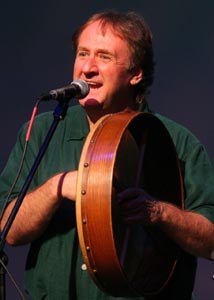
Robert Tincher playing the bodhran.
Last Friday we went to see Robert Tincher perform at the library. He is a Kentucky native musician who specializes in Celtic and Folk music. In honor of St. Patrick's Day, he did a program called "Roots and Branches", exploring the Irish roots of Appalachian music.

The kids kind-of zoned out, but I had a great time! Mr. Tincher explained in detail how the Scots-Irish came to the Appalachian mountains, beginning his story in the 1500's and interspersing his dialogue with songs, some of them which he performed first in their original Celtic version and then again in their Appalachian version, illustrating how some songs changed but amazingly remained very much the same, something that is unique about Appalachian music and language, something I love.

Some enlightening things from the concert:
1. The song the kids sing called "Shady Grove" is derived from the original song called "Maddie Groves" - which was an adulterous murder ballad (no surprise). Have heard both songs but never made the connection. Makes total sense now.

2. Irish folk song called "Skuball" which is a true story about a race horse, became the famous folksong "Stewball".

3. Froggie Went A-Courtin' was originally written as a wedding song for Mary Queen of Scots in the 1500s (she was Miss Mousie). It's hardly changed at all and still sung in the mountains (and by my kids).

4. Most importantly, we confirmed some things we always thought about our Appalachian Scots-Irish heritage: They were independent people who wanted their freedom, after having served for several years in America as indentured workers, they fled to the mountains. Their heritage and character even in Ireland was as noticeably wild, independent and proud people - also deeply religious and determined to worship God in their own way. All these traits have continued nearly unchanged in the mountains where they finally settled and hid out, perfectly content to live their lives their own way and not be bothered.

5. Interestingly, Tincher even mentioned their great love of sports (probably connected to the Scottish clans and games), which in my own warped way I think explains the great love of basketball by the people of Kentucky. Ha!

Saturday, February 12, 2011

February 11, 2011

Today we read a great book called:


My Great-Aunt Arizona by Gloria Houston. Jessie and TJ are going to tell you about it:
From  TJ
My Great Aunt Arizona is sort of like a book about the life of a girl named Arizona. 
Arizona is exactly like Jessie. She loves to read, sing, "Square dance to the fiddler on Saturday Night", and she likes to grow flowers.She loved going to school with her brother Jim. Soon, she had read every book in the school she went to. So, she traveled to another school in a place called Wing. But, soon her mother died. So, she wasn't able to go to the school in wing because there was nobody to care for Papa and Jim. So, she stayed in Henson Creek where they lived. But then, Papa got a new wife. So, she would be able to go to a school where she could learn to be a teacher. Her Aunt Suzie offered her to stay with her and help with the chores. The work Arizona did was hard but, at night she was able to study and do the things she liked to do. She soon returned to her home. She was a teacher at last. She taught at the same school she went to as a kid. She started teaching at ANOTHER school when she married a man that built the school she was teaching at. She taught a class of 4th graders that called her "Miz Shoes". She soon had a daughter and brought her to school when she was teaching. For 57 years, she taught the 4th Graders. She also taught her brother Jim's only son. One of the things she said a lot in this book was this: "Her students would ask her "Have you been to the faraway places you always talk about?" "Only in my mind." she answered. "But some day, you will go.""

From Jessie
My Great Aunt Arizona is a book about the life of a girl  named Arizona. Arizona is just like me. She loves to read, plant flowers, sing, and "square dance to the fiddler every Saturday night". Arizona attended a one-room school with her brother Jim. At recess they played games like "William Matrimmatoe". Pretty soon she had read every book in the one-room school. So she traveled on her papa's mule to a different school in a town called Wing. One day, Arizona's mother died, so she could not go to the school in wing because there was no one to take care of her papa and Jim. So she stayed home and took care of her papa and Jim. But, she still loved to read and dream. She dreamed of the far away places she would visit one day.

One day, papa brought home another wife. Arizona could go to school now and learn to be a teacher. Her aunt Susie invited her to help at their house. Aunt Susie made Arizona work very hard, but every night she had time to study and dream of the far away places she would visit one day. Soon, she went back home and she was a teacher at last! Arizona taught in the one-room school house where she and Jim had once sat. she made new chalk boards. She had flowers growing in every window. She taught the children their letters and numbers. She told them about the far away places they would one day visit. "Have you been there?" the children would ask. "Only in my mind" She replied. "But someday you will go". Soon after that, Arizona married the carpenter who built the new Riverside School down where Henson Creek joins the river. So she became "Mrs. Hughs" and when she taught the fourth grade students they called her "Miz Shoes". And when her daughter was born she brought her to the school while she taught. Every year, Miz Shoes had a Christmas tree growing in a pot. The kids would decorate the tree with paper decorations every year and then they would plant it out in the school yard. Soon, there were so many trees that they were like guards guarding the school yard. Arizona's students had kids who were taught by her, and they had kids who were taught by her. 
Arizona died on her ninety-third birthday. She never got to go to those far away places she always dreamed about. But she travels with those she taught, and those she touched.

Monday, December 27, 2010

The Lawsons celebrate Old Christmas

This year we have decided to prolong our Christmas celebrations into the Twelve Days of Christmas, or, as  they call it in the mountains, Old Christmas.

Winter snow in the Appalachian Mountains
Now, we're not against people taking their tree down and putting Christmas away in boxes on the 26th, but at the Lawson house we always look for a way to prolong parties and festivities. So, we have revived a tradition from the mountains that takes the celebration all the way to January 6th.

As far as I can tell, Old Christmas has its roots in the fact that they changed the calendars way back when, and Christmas used to be on January 6th. That's why they call it Old Christmas. Now, it also coincides with Epiphany, the day celebrating the visit of the Magi to the baby Jesus. Needless to say, Appalachians just use it as an excuse for more parties, more feasting, more music making. And, we're all for that. Why should Christmas come and go in just one day?

So, although we're officially on break from school, we're still learning about Appalachian culture. Here's some of the fun things the Lawsons are doing:

Jessie and TJ are attending Christmas Country Dance School all week. This is an event held at Berea College which teaches and celebrates traditional dancing and music. The kids are learning about Molly dancing, country dancing, clogging and Danish gymnastics. They will be part of a performance on New Year's Eve.

This is very much like what the mountain people would probably be doing on the Twelve Days of Christmas - dancing and making music. In fact, I heard of a fiddle tune and song about this  called "Breakin' Up Christmas".

We also attended, this evening, a performance by the Morrison Brothers Band, who are part of the Christmas Country Dance School staff. They were pretty good! Looking forward to the concerts and family dances during the coming week.

Thursday, December 23, 2010

T.J.'s end-of semester project

For my Project, I chose to do an Oral History Project. I Interviewed  my Grandmother. Her name is Dottie Lawrence. These are the questions and the answers that I asked my Grandmother. She grew up in Drift, Kentucky. She was born on October 15th 1951.
TJ and Granny Dot


Appalachia in Person

School

Q: Describe your classroom in 4th Grade.

A: It smelled. There was this smell in Drift school. I went to Drift Grade School. We walked to school. And, when you open the front doors, it was a nice school for that time. But, you opened the doors, and it always had this smell. I think it was a combination of, you know like when you sharpen pencils, you know how that smells sometimes? It was that. And, oil that went on the floor in the hallway, that kind of thing.
My room had a front door to it. You go in the hall, my room was over on the left. And, it had glass in it, but it was glass you couldn’t see through. It had a wooden bottom, and then glass panes. Well, you go into the room and there was a whole row on the side of closets. Closet space: it was almost like closets in a house; you pull the doors and, it would kind of fold back. And, that’s what the teachers stored their stuff in.
The teachers desk was usually in the front or over in the corner. And there was a regular old chalkboard. There were no dry-erase markers or anything like that. It was just a chalkboard. And, all the desks; have you ever seen one of those old desks? Ours had the things that raised up. You can store your stuff in it. And, it also had space under it where you could put your books. Cause we only went to one room. We had every subject in one room. And, of course we had maps on the walls. And, the globe. And, they had the ABC’s up around the top. And, the 123’s. And, there was always a place in our room where we have a bulletin board where we could put stuff we made. That kind of thing. And, it was almost like a school now. It was a little different. And, good teachers.

Q: Who was your favorite teacher and why?

A: My favorite teacher was Orphie Akers. Because she was like a grandma to everybody. She loved everybody. And you could talk to her about anything. You can talk to her about school work, you could talk to her about anything. And she’d listen. She would just listen to you. And, as a matter of fact, she lived by the school at that time. And, she’d send you over to her house to get stuff. She was a nice teacher. I liked most all my teachers. But I liked her best. She was real nice.

Q: Describe one of your funniest stories from elementary school.

A: Okay. I’ll tell you about this time when I had a little accident in school.
We had a playground in the front. And, I was gonna show off in front of this little boy. As a matter of fact, he’s the same guy I have on Facebook right now (we grew up together).
I was gonna show off in front of this little boy. Cause I was gonna swing. I was gonna show him how high I could swing. I got into the swing, and somehow I got off balance. It wasn’t funny when it happened but, now it’s funny. I got off balance and I fell and, you know how the swings are at playgrounds cause they have those big poles. I hit my chin on the pole. My face turned blue. It was blue all the way under my eyes. It looked like somebody had been beatin’ on me. And, of course he thought that it was funny. He didn’t know I killed myself! But he laughed.  He thought it was funny. And, you should’ve seen me. For two weeks, I had a blue, purple face. And your great granny thought that I had absolutely killed myself. But, that was funny. It wasn’t then, it was funny now.

Life Growing Up.

Q: What chores did you have growing up?

A: Everything. My Mom worked. And, there was nobody at home but my sister and me. NovaLou. And, she was older. I was the younger. And, we just did everything that had to be done. Anything that our mom left us to do. ‘Cause she was not there a lot. She got up and she went to work when we went to school. And, she came home right before we came home. And, on Saturdays and Sundays, we stayed with our Grandma. So, we did everything. We cleaned the house. We didn’t cook a lot. My Mom did that. We cleaned up. We did dishes, we cleaned up and stuff like that. But, we tried to help her. We did everything we could to help her out, because she worked a lot.

Q: Describe your family.

A: My family. My immediate family; there’s only me and my sister NovaLou, my mom has been  passed away for quite a while. But, growing up there was my mom, and me, and Novalou. And then, there was my grandmother, and my Aunt Evie, my Aunt Annie, and my Aunt Pearl. They lived across over on the other side of the hill. And, that was our family. And, our family liked things like music - kind of like you do. And, that’s what we did. That’s what we did all the time. And, when my grandmother all of my moms family (cause she was the oldest of 13 children! And, Aunt Pearl was the youngest of 13 children) would come back from where they’d moved to Ohio, and Michigan….when they would come back home, they’d come to our house. Because, Granny Pack was gone. She’d passed away. And, that was the only place they had to go. So, they’d come to our house and, we would cook outside, we’d set up a big fireplace with a big grill thing on it, and, it went back in the hill made out of brick. We’d cook outside, we’d have so much food. And, they would sit up all night and play music. We’d string lights up outside in the front yard. And, I had a good family. A lot of them are gone. Now it’s kind of strange because my family now is all younger. They’re my children, Aunt Nova Lou’s children, you guys, Alyssa and Josh and, extended family all over the place. All the way out in, well, even in Arizona!

Q: Tell a favorite memory about your parents and grandparents.

A: I can’t tell you a whole lot about my parents because I don’t remember my Daddy. My Mom. I’m a lot like my Mom. She was funny. She liked to have a good time. She liked to have her children around. She liked to have her whole family around.
My Mom always waited up for us. After we got older, we went out a lot. We went out on dates, went out to ball games and stuff like that. And, she always waited up. She never went to bed till we got home. And, if she did lie down, she’d always stay awake. She wouldn’t sleep. So, one time she went out and, me and Nova Lou stayed home. And, my Mom liked to do square dancing. She’d go out. She had some friends of hers. They’d all go out and, they square danced. Well, you have to remember: we didn’t have a dryer. So, we had to hang up clothes on the front porch. When it was rainy, you couldn’t hang them out, they’d get wet. So, we had to hang up clothes up on the front porch. She had clothes lines up across the front porch. And, we were watching TV. We had this big ol’ TV with the big legs. And it was a scary show. And, the doors were locked. But, we heard somebody out on the front porch. We were up on this mountain. No one was around but us, and Granny Packs house. And, clothes were hanging up so we couldn’t see. And, when she….(it was my Mom) she got to the door and, it started to open. And, it scared the day lights out of us. But, we couldn’t see her because the clothes were hanging up. And, you couldn’t tell who it was!
And, my Grandparents. I don’t remember my Grand Daddy. He was gone before I was born. But, my Granny Pack. Oh, she was a hoot. She died young. She was 51 when she died. And, she worked hard all the time.  She was a real pretty woman. And, she threw a tea cup one time at Aunt Pearl. And, that was kind of funny. But, Aunt Pearl didn’t think so. Granny told her to do something and, she would say, “No. I don’t what to.” Or something like that - she was a teenager. And, so Granny was sitting on the front porch, she was in the swing, swinging, and her front porch was a high front porch. And, Aunt Pearl told her something that she wanted her to do. And, I don’t remember what it was. Granny Pack was drinking a cup of Coffee. And, she had finished her coffee. And, she was sitting there holding her coffee cup. And, Pearl turned around and said something to her about not wanting to do something. And so, Granny Pack just politely threw the cup at her. That was Granny Pack.

Q: Describe what it was like when your family got together for special occasions.

A: Like I said: music. People up in the holler would sit out. And, when they knew that all of my Mom’s family was back home, they’d sit out on their porches at night to listen to them play music. They all played guitars, and banjoes, and all kinds of stuff. And, when they all came back home, and people around there knew them (grew up with them) that played, too, they’d all come to our house and we would sometimes have 75/80 people at our house. And, like I said, we’d cook out, string lights. Some of them played Rook (they played cards). But most of them played music. And, that’s how I got involved in music. Cause, I loved it. They played bluegrass music, gospel music, and, it was good. And, that’s what we did. And, everybody just had a good time. They didn’t drink. They didn’t do anything like that. They just had a good time. Sometimes, we would have people laying all over the house at night cause they would just fall asleep. We had kids laying in the floor, and out on the porch. And, they’d play until daylight. People would just stay out, and listen. And, we were always called The Pack Family. So, you take that from them.

Q: Do you remember anything about your great grand parents?

A: No. Not really. Just things that I heard. Things that I heard people say. But, I don’t remember them because……..my Daddy was killed before I was two. And, my grand Daddy…the only grand Daddy I had left died January after my Daddy got killed. My Daddy was killed in August. Great Grand Daddy Shannon died in January. And, Great Grand Daddy Pack was dead for a long time. My Grandmother Shannon had been dead for a long time. So, it just left my Granny. She was the only one I had. So, I don’t know a lot about them… but I DO know this. My Grand Daddy Shannon looked like something from The Hatfield and McCoy Feud. He had a handlebar mustache. He was a lil’ bitty feller. He wasn’t really big. He was so mean. They told me that he was the meanest thing. But, that’s all I know about him. I just know him from pictures.

Q: Tell me what you thought about coal mining as a little girl.

A: Never really thought too much about it because every body did it. You know it’s kind of like saying everybody in the neighborhood’s a teacher, everybody in the neighborhood is a nurse or something like that. Everybody worked in the coal mines. And, I mean, it was nothing to see a whole bunch of coal miners walking out in the holler, because when the shifts changed, they’d all walk out together. They didn’t drive a lot; there wasn’t a lot of cars or anything. And, the only bad thing about it is your house never stays clean. ‘Cause you had coal dust on everything! But that was the way you made a living. And, I never really thought about it, until I grew up. And, then I knew about the dangers. I had a lot of family that got hurt in the mines, that got killed in the mines. My Grand Daddy Pack got killed in the mines. My Daddy was killed in the mines. My Uncle Harry was killed in the mines. It was one of those things that you didn’t think a whole lot about. It was just a part of life. But, after I got older, and, I started to realize what a bad thing – well I don’t wanna say a BAD thing. Because, coal mining isn’t any more dangerous than getting out and driving a truck for a living. It’s just the thoughts of getting back up in the hills. And, it feels scary. Of course, Uncle Ben does it. He loves it. And, he wouldn’t do anything different. That’s what he wants to do. I just never thought a whole lot about it. It was just what we did. And, they did it well.

Jessie's end-of semester Appalachian Project

For our Appalachian studies we had to choose a project to do. This is the project that I chose to do: I made a pot holder, and I did everything by hand.
   I started by measuring out the pieces, and cutting the pieces out. Then, I pieced it together, and sewed the back to it. Then, as you can see in the picture above, I quilted X's on each square. I used blue/green thread on the dark green cloth and dusty yellow for the flowery pieces, which is why it is hard to see.
   It took me about four hours to cut the pieces, piece the pieces together, then sew the back to it. It took me two and a half hours to quilt it.

   Quilting was not an art a long time ago in Appalachia. It was more of work to make them warm. They were almost always made out of old clothes or blankets or anything that was cloth, and could be sewn. But now it is an art to make quilts because they do not make them a lot now a' days.
   All I know is that it was fun making it and it will be very useful to my parents! It was very easy to make and the only time I asked for help was when I was cutting out the pieces and sewing the back to it! I also plan on making a quilt soon. Can't wait to get started!

Tuesday, December 21, 2010

Appalachian Christmas Stories

Today we read two great Appalachian Christmas stories:

Silver Packages: an Appalachian Christmas story by Cynthia Rylant. And...
Littlejim's Gift: an Appalachian Christmas story by Gloria Houston.


The kids enjoyed both of them so much they wouldn't let me take them back to the library. Silver Packages is mostly based on the true story of the Santa Train, a train that began in 1943, going through the mountains distributing gifts to children.
   Littlejim's Gift is set in the mountains of North Carolina during the first World War, but it included many Christmas traditions that were typical in many towns all across Appalachia, including recitations in church, the tradition of St. Nicholas coming into the church to give out gifts, and each child (and adult!) receiving a brown paper poke (bag) with oranges and nuts and candy inside.
   In other news, the kids are hurrying to get their end of the year projects finished. Jessie is sewing wildly on her quilt and and TJ has his questions ready to interview Granny Dot today. Projects should be up and on the blog soon!

Thursday, December 2, 2010

December 2, 2010

So, we've finally finished our journey through Faces of Kentucky, the Kentucky history textbook. Jessie and TJ are each going to blog about their favorite subject in the book. Jessie chose to write about one-room schoolhouses and what it was like to go to school in the early days of the Commonwealth. TJ wants to write about Kentucky musicians and songwriters. Here goes:

Jessie writes:
So when schools first started in Kentucky there was a lot of danger, violence and just lots of bad stuff happening. But everyone thought that kids should be taught even if there was danger everywhere. So kids started having school in forts and then rough schools. Adults back then had a different view of school. They thought that schools shouldn't be public, which means they shouldn't be paid for by the State. So many private schools called academies started. So the education of Kentucky wasn't going so well. But after all this, one room schools that were public started showing up. Those schools were not very good schools because there could be fifty students and only one teacher in each school. Also because there was a lot of school violence such as kids bringing guns and knives to school. But that is not new now in our schools. Lots of one room schools were not built very well. One school was made out of logs, so the cracks in between the logs were very poorly filled. So the cold wind would blow through regularly. One boy recalled, "The ink could not keep from freezing." Mainly the only furniture in the schools were benches with no support on the back, a coal or wood stove to keep the school warm, a desk for the teacher, a water bucket for water. If they ran out of water they either had to get it from a well in the school yard, or from a stream or spring far from the school. Sometimes the schools would have a black board. The black board would be a wall thats painted black or just a plain black board.  So a man named Robert J. Breckinridge observed that many of those schools were only getting $15 dollars from the state. So Breckinridge got a tax passed so that the schools got all the money they needed.

TJ writes:

When the Europeans came to Kentucky, they brought music with them. They sang songs to other people, but by memory. Kentuckians have used a lot of folk songs that were like the songs that the Europeans sang. The people such as John Jacob Niles,  from Louisville and then central Kentucky, Mary Wheeler from, Paducah, and Jean Ritchie from Perry County in Eastern Kentucky wrote down the songs that the Europeans sang. They didn't want these songs to be forgotten. These songs told the people about families, and times long ago.

Kentucky didn't just play folk music. They began to write new songs and music. One of those people that wrote original music was Stephan Collins Foster. He wrote My Old Kentucky Home," and "Oh! Susanna." The song called "Oh! Susanna" is "the birth of pop," and he wrote many songs that we sing today. He wasn't really connected to Kentucky except for the title of the song, "Happy Birthday."

 
In the the next century, music from Kentucky started to become popular in the USA (United States of America). Country music became very popular, and people from Kentucky made it popular. 7 people at least whose hometown was in Kentucky or made their home Kentucky made it to the CMHF (Country Music Hall of Fame). The 7 people that went to the CMHF included, "Red" Foley from Madison County; "Pee Wee" King, who lived in Louisville; Merle Travis from Muhlenberg County; "Grandpa" Jones from Henderson County; Loretta Lynn from Butcher hollow; and the Everly Brothers from Brownie, Kentucky.

Friday, November 12, 2010

November 12, 2010 - TJ writes about coal mining

Coal Mining was a big deal in Kentucky. That was one of the main jobs you could work for. Here is a story about a coal miner named, "Sam Hawkins."

Sam Hawkins was an African American miner who dug coal out of the hills near Fleming, Kentucky, (in Letcher County). The year of 1932 wasn't a good year for Sam Hawkins. Hard times like this year meant less jobs and smaller pay checks. It was really hard for Sam because that was the year his wife, Sadie Hawkins, died. Sam was 48. The love remaining of his life was the only child he had, Margaret, who was 19 at the time. Margaret had gone to college at what is now KSU (Kentucky State University). Sam couldn't read anything, but he hoped Margaret would have a better future then he had.

But, one day, things got worse. A man read a letter to Sam that was from Margaret. In the letter, she told him about how school was going, and that she was doing well. Then she wrote, "I think I'm gonna have to quit school in a few days. I'm out of money. Unless you can send me $10, I will have to come back home." Back then, $10 is like $10,000 today. He couldn't borrow the money because I'm sure there wasn't a lot of people around that had $10 on them. Sam went to his boss. His boss said that there was a section of a mine that was too dangerous to mine. It could cave in at any time. But if Sam wanted to try it, his boss would let him. The pay was 31 cents every 2,000 pounds of coal. Sam dug coal for almost 5 hours, then he ate some food. Then he dug coal for the rest of the night. The walls groaned but held. He kept working. 20 hours later, he came outside, to rest for a little bit. The wall of the mine fell. Sam mined all his coal and was quick enough to survive. He got $11 for digging coal. That's about 70,000 pounds of coal! He sent the money to Margaret. She soon got her college degree, and she came back and taught.

AND THEY LIVED HAPPILY EVER AFTER (except that Margaret died).

Harry Caudill wrote a book about this story. At the end he used these exact, same words, "Sam had put little white markers at the graves of his wife and his daughter but no one ever got around to making his own. Perhaps a coal shovel thrust into the earth like a bayoneted rifle over the bones of a fallen hero would be appropriate for such a man."

THE END!

Thursday, November 4, 2010

Slavery and Civil War

Jessie is going to write about slavery and how it led to the Civil War:

Slavery was a big thing in Kentucky when people first started to live here. As you might know most slaves were African American, and back then people thought that African American people were not as important as them (White people). So, as I said before, there were many slaves back then. So many that most Kentuckians (except for those who couldn't afford them) had at least one slave. Though many slaves did get freed or fled.
I read about one man who worked as a slave, but also had a job so he got paid. Very few slaves got the opportunity to have two jobs and get paid for one of them. The man had a wife and I think a few kids. He worked and worked and earned money until he had enough to free his wife. Then he worked more and earned more money until he freed every one, but himself. He kept working to free more and more slaves that were friends and family. Finally he freed himself. Very few slaves get that opportunity to free themselves. Though most slaves got freed when they were a certain age or when their owners died. So there were slaves everywhere!
The sad thing is that a lot of families, if slaves, get separated. I also read that one time at an auction, a family of slaves, a mother and a father, three kids, one four, one eleven and one just a few months old, were sold. First the eleven year old was sold, then the four year old -to another person- then the mother came up holding the baby,someone yelled out "Sell them separately!". So the baby was taken from the mother and the mother, father, and baby were all sold separately. Isn't that sad?
It got so bad that the north started to do something about it. And that started the Civil War. The Civil War had two sides. The north side, that was called the Union. They were against slavery. The south side, that was called the Confederacy. They were for slavery. I do not think that slaves fought, but I do not know for sure.
A sad thing about the war was that a lot of families fought against each other.I heard many stories about that. I also read about these two girls who were both from different sides, were talking about one side. Here is what they said: Girl #1 from South talking about North: "They were the worst things I had ever seen. Instead of uniforms, they were wearing old gray cloaks and looked absolutely miserable!" Girl #2 talking about North. From north: "The people who are fighting on our side are absolutley wonderful! The general is the right man for the job and is very handsome!"

That is pretty much all I know and can remember from what we have read about slavery and Civil War.

Tuesday, October 19, 2010

October 19


Last Wednesday, we went on our field trip to the Kentucky History Museum in Frankfort! The quote on the building says, "...so all Kentuckians may discover their roots in time and place."


The kids and Daddy standing on a model of a boat pioneers used to travel down the Ohio river to get to Kentucky.


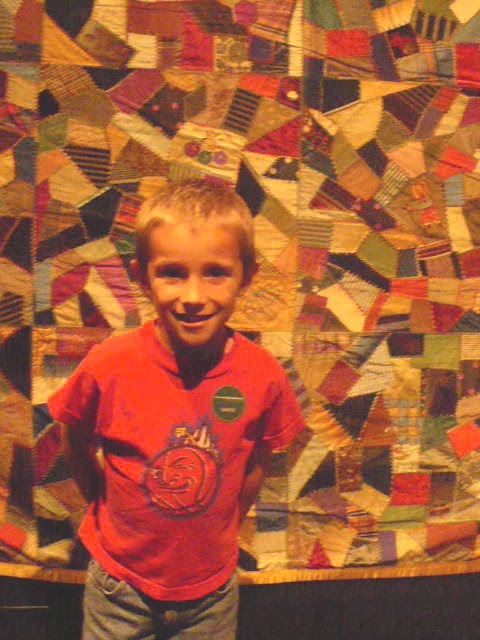
They wanted their picture taken in front of every quilt. There were a lot of quilts!


My friend, John G. Fee. I just had to take his picture.


TJ writes: This is Abraham Lincolns REAL watch. The watches back then are different then the watches of our time.

Abraham Lincoln was born near Hodgenville, KY, on Feb. 12, 1809. He died at age 56. His family left KY 7 years later.

When Lincoln was talking about the Civil War, he said:
"I think to lose Kentucky is nearly the same as to lose the whole game..."
Abraham Lincoln, 1861


David wanted his picture taken in front of this crazy quilt. Crazy boy, crazy quilt.


What can I say. We like quilts.


Jessie wanted to take this picture of a Victorian-style living room.


A piece of Kentucky coal.


Authentic moonshine still. Ha ha!


Coal miner's equipment. They had a big section for coal mining, including a set-up of a company store with a display of scrip. Tim explained it all to the kids. They decided the company stores were a rip-off. After you got paid your scrip and bought your stuff, you didn't have much money left.


Coal camp in the mountains of Eastern Kentucky.


Jessie writes: This is David in front of one of my favorite quilts at the museum. It was made by a little girl, but that girl did not finish it until she was around fifty years old (I think). The top of the quilt took her a few years to make. She started at the age of eight and she was about ten or eleven when she finished the top. If you look at the quilt closely,you can see that the pieces are very small.She finished the whole thing when she was around fifty, or fifty five years old, at the beginning of World War II. I learned that a lot of the only blankets that they had back then were pretty much all quilts, even though they all took extremely long to make. Back then,
materials for quilts were expensive, so sometime people, when they made quilts, used old clothes, or any other cloths.


Swinging bridge over a creek at a home in the mountains. You can still see bridges like this in Eastern Kentucky. We all walked across one before!


Small tobacco farm in the mountains.


This is the ACTUAL CAR that Bobby Kennedy rode in during his famous tour of Eastern Kentucky.


When we got to the exhibit about Kentucky in the '50s, '60s and '70s, Tim stared at this TV for a long time. "I had one that looked just like this growing up!" he said. I took a picture and didn't know until I went back that I had caught Colonel Sanders on the screen!


When we left, Tim took a picture of us standing on Madison County on the Kentucky floor map in the foyer. Then we went and got ice cream. It was a good day!

Tuesday, October 5, 2010

October 5

Today we started focusing on Kentucky specifically by studying Kentucky history using the book Faces of Kentucky by James and Freda Klotter.


This is one of the better textbooks I have seen in ANY subject area. All three of the kids sit and listen for the most part, although David sometimes listens upside down with his legs in the air. We have started by reading about the first Native Americans in the region. Interestingly enough (this is something even I didn't know) when the majority of European settlers came to Kentucky, there were very few Indians living here. Almost all of them had died out due to disease. Kentucky was mostly just a hunting ground that Indians from Ohio or other areas passed through on hunting trips.

This book has also inspired us to try and schedule a day to visit the Thomas D. Clark Center for Kentucky History in Frankfort. If we go, we will be sure to take pictures and blog about it.

We also have discussed our projects that Jessie and TJ will each have to do at the end of each semester. Here's their list of options:

1. Write an essay titled "Why I am Proud to be an Appalachian."
2. Write a poem about Appalachia.
3. Create a portfolio of photography on an Appalachian theme.
4. Write and perform a bluegrass song on a traditional instrument.
5. Create a handmade craft in an area of traditional Apppalachian art/craft.
6. Interview a person who grew up in the mountains and write an article or blog about their life.

Each student chooses one project to complete in the fall and one in the spring. So far, it looks like they both want to do a photography project, Jessie wants to do a handcraft, and T.J. wants to do an interview. This should be interesting.

Wednesday, September 29, 2010

September 29

Here's what Jessie writes after reading "Growing Up in a Holler in the Mountains":

I am going to write about Coal Mining.
A lot of miners would get a disease called black lung from working in the coal mines for very long. They say that the disease was very very serious, making it hard for miners to breath, or work. but when miners got the disease, the coal companies would not give them a pension, leaving them with no work or income. To get coal companies to give better working conditions and better salaries, the miners organized into unions. The unions said they would go on strike. So the miners went on strike, which left the coal companies with no workers. So they brought in new workers from different states and countries to work for them. The union members called them Scabs, and had great contempt for them. Soon the strike ended with the union winning. Which left the coal companies giving better benefits and salaries.

Monday, September 27, 2010


On Saturday, September 25th, the kids did an art project using torn construction paper to create scenes and landscapes. TJ made a city scene and David made an ocean scene. The weather was cooler on Saturday as we are entering the autumn season, so Jessie made a picture of Appalachian Mountains in the fall.

Thursday, September 23, 2010

September 23

We finished reading "Growing Up in a Holler in the Mountains". The kids are each going to blog about one subject of Appalachia that we read about in the book. TJ has chosen to write about Appalachian music. Here's what he learned, in his own words:

Appalachia has a long history of music. The main styles of music in Appalachia are Country, Bluegrass, and Southern Gospel. Some children of Appalachia like to listen to music thats more like Rock.

In lots of Appalachian Festivals, there is lots of music that is played on mostly Guitar, Banjo, Fiddle, Dobro, and Bass Fiddle. Some people that aren't big groups play under tents and people come to listen.

People in Appalachia still play Scotch-Irish music. The music that they play now doesn't have bagpipes. But, people still play the music that is now played in Ireland and Scotland.

Friday, September 17, 2010

September 17

Today we started to read a book called "Growing Up in a Holler in the Mountains: An Appalachian Childhood" by Karen Gravelle.


We like it because it is about a boy who is close in age to Jessie and TJ, and he lives near Martin, KY, where Tim grew up. Joseph Ratliff is a real boy and his family has lived in Stephen's Branch for over 200 years. Joseph tells how his ancestors came through the mountain gap from Virginia, just like Tim's family. I like this book because it explains the ethnic heritage of the people who live exactly where Tim's family lived, so the kids can really relate to it. They described why the Appalachian people are mostly Scotch-Irish, English, and some German, as well as a few who also have Cherokee blood. This is exactly the heritage of Tim's family. The kids asked a lot of questions about their heritage, so that was good.

In this book, the boy and his family live in a dogtrot cabin. So, I asked the kids to tell me what a dogtrot cabin was. Here is their answer in their own words:

Jessie writes:
A dogtrot cabin is like two cabins because there is a small corridor in the middle of the cabin. They call it a dogtrot cabin because dogs use the corridor to get to the front or back yard.

TJ writes:
Well, A Dogtrot cabin is basically 2 cabins that have the same roof on top. And in
the middle of the cabin is where most people put a fireplace to warm up both cabins.
But, in the book that we were reading, the people had a wood-burning stove. Also, where the space is between the 2 cabins is where the dogs go from the front yard to the back yard. That's why it is called a Dogtrot cabin.